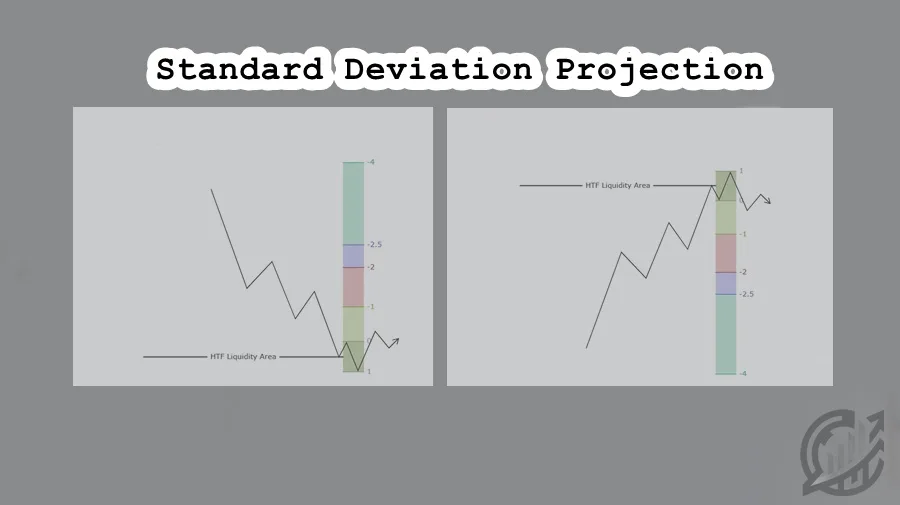
Financial markets move by creating swing highs and swing lows. This shows trend continuation. Just like a break of structure for continuation, a Change of Character (CHOCH) occurs for a trend reversal.
CHOCH represents the moment when the market shifts from a bullish to a bearish trend, or [bearish to bullish], indicating a potential reversal. Traders often use this shift to identify high-probability trade setups.
This “character shift” is not just a pattern; it is a declaration from the market that the dominant side (buyers or sellers) is losing control. Understanding CHOCH in forex trading is what separates traders who chase price from those who anticipate it.
Unlike a Break of Structure, CHOCH signals the potential end of the existing trend. It is the market’s earliest confession that something structurally has changed.

Table of Contents
What is Change of Character (CHOCH) in SMC?
Market movement is fractal in nature. This allows the market to move higher by creating higher highs and higher lows in an uptrend (bullish market), and move lower by creating lower lows and lower highs. Pullbacks and corrections are the reality of the market. SMC and ICT traders analyze each move of the market in order to identify traps in the market.
Change of Character (CHOCH) is the sign of a reversal of the existing trend. The change of character aids in identifying reversals in market trends and provides an opportunity to trade against the existing trend. It signals a potential trend reversal. It enables traders to find new opportunities in the market.
Change of character occurs in both uptrends and downtrends. In an uptrend, change of character occurs by breaking the previous higher low. In a downtrend, change of character occurs by breaking the previous lower high.
Pro Tip: Don’t judge a CHOCH from a single candle wick. Many false signals happen because traders react to a brief spike through a level rather than waiting for a full candle close. Treat a wick-only break as a warning to pay closer attention, not as confirmation on its own.
Valid Change of Character (CHOCH)
Perhaps the most critical skill in SMC CHOCH trading is learning to identify a valid change of character versus a false one. The market is designed to deceive, and the formation of fake CHOCH signals traps retail traders on the wrong side.
A valid change of structure must meet the following criteria:
- It must break the correct structural swing. A valid CHOCH breaks the swing high or low. Internal swing points, minor highs and lows that form within the broader structure, do not count.
- Price must close beyond the level, not merely wick through it. A candlestick wick that pierces a swing high or low but closes back on the other side is often a liquidity sweep.
- Context must support the reversal. A valid change of character carries alignment with a higher timeframe bias shift.
- After a valid change of character, the market should begin forming structure in the new direction.
Why CHOCH Matters in SMC Trading?
In SMC analysis, CHOCH is an event in price action that is treated as one of the most reliable signs that institutional order flow may be shifting direction. Institutions move large amounts of capital, and their footprint often shows up first as a break of structure before the broader market catches on.
Pro Tip: Treat CHOCH as a bias-changing signal, not an automatic entry trigger. The safer approach is to wait for price to retrace into a point of interest — such as an order block or fair value gap — after the CHOCH has formed, rather than entering the instant the break happens.
How to Identify Change of Character?
In order to become competent in SMC analysis, it requires a consistent and repeated process. Here are the simple steps for beginners.
Step 1: Confirm the Existing Trend
Before you can spot a change, you need to know what’s changing. Identify whether the market is currently forming higher highs and higher lows, or lower highs and lower lows.
Step 2: Mark the Key Structural Point
Locate the most recent higher low (in an uptrend) or lower high (in a downtrend). This is the level that must be broken for a valid CHOCH to occur.
Step 3: Wait for a Confirmed Break
As with most structural events in SMC and ICT trading, a wick alone is not enough. Wait for a candle to close beyond the key level before treating the CHOCH as valid.
Step 4: Check for Supporting Context
Look for a fair value gap (FVG) or order block left behind by the break. These often becomes useful reference zones for a future entry once price retraces.
Step 5: Watch for a Follow-Through Move
A genuine CHOCH is often followed by continued movement in the new direction, rather than an immediate snap-back to the old trend. If price quickly reclaims the broken level, the CHOCH may have been a trap rather than a real shift.
Pro Tip: On lower timeframes, CHOCH signals appear far more often and are less reliable individually. Before trusting a CHOCH on a 5-minute or 15-minute chart, check whether it aligns with the broader direction on a higher timeframe — disagreement between timeframes is one of the biggest sources of false signals.
Major and Minor Change of Character
Not every change of character carries the same weight. The difference between major and minor CHOCH helps traders filter out low-quality signals.
A major change of character typically appears on higher timeframes, such as the 4-hour or daily chart, and is usually accompanied by a strong displacement move nd clear supporting zones like an OB or FVG.
A minor change of character tends to appear on lower timeframes and often reflects smaller, short-lived shifts that may not represent the true higher-timeframe direction. In ICT methodology, MSS is used to find shifts in smaller timeframe structure.
Pro Tip: Use minor CHOCH signals for timing your entries, but rely on major CHOCH signals for setting your overall directional bias. Confusing the two — treating a minor, lower-timeframe shift as a full trend reversal — is one of the most common mistakes new SMC traders make.
Change of character in Bearish Market (Downtrend)
Change of character in a bearish market is referred to as a bullish change of character. In a downtrend, the market creates lower lows and lower highs. A change of character from bearish to bullish is a critical moment. This is because the market signals a potential reversal. It occurs in the following way:
As the bearish trend continues, there comes a time when the price fails to create a new lower low. This is an indication of weakening selling pressure. This weakening of selling pressure sometimes leads to a change of interest, and the market for a moment goes sideways (Wyckoff referred to the phases as accumulation or distribution phases).
The first sign of a potential reversal happens when the price fails to respect the previous lower high. This is also referred to as “Break of structure in opposite direction.” Price breaks above this lower high, creating a Higher High. This break is significant in market structure because it represents that buyers are gaining strength.
After that, price retraces back but fails to drop below the previous lower low. On the contrary, it creates a higher low. This confirms the bullish structure. If price forms another higher high, it indicates potential strength in a trend reversal. This is the end of the bearish trend phase and the continuation of the bullish one.
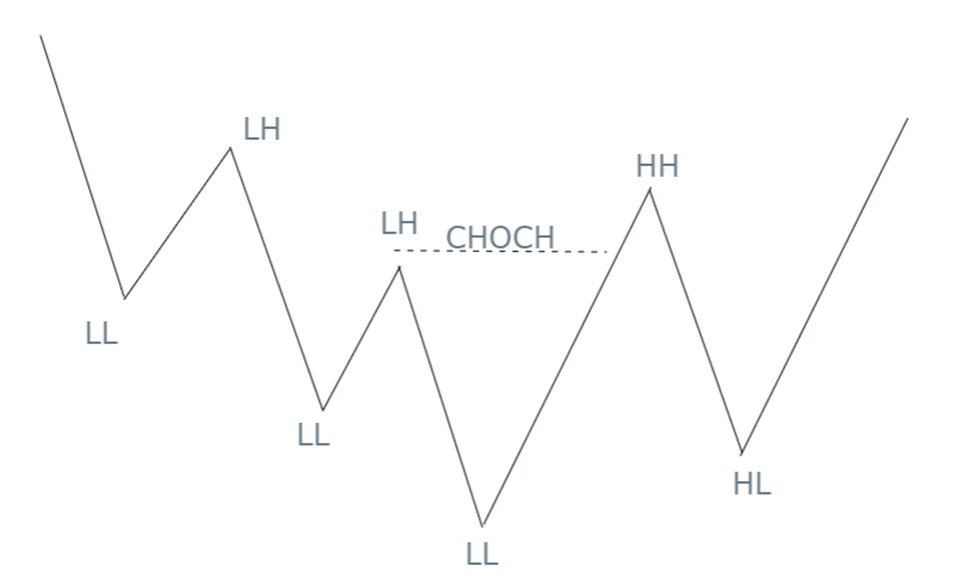
A bullish Change of Character is a critical concept in technical analysis, indicating a trend reversal from bearish to bullish. By breaking the structure of Lower Highs and forming a Higher High, the market signals that the downward momentum is weakening, and buyers are gaining control. For traders, recognizing this shift can provide lucrative opportunities to enter long positions in the early stages of a new bullish trend.
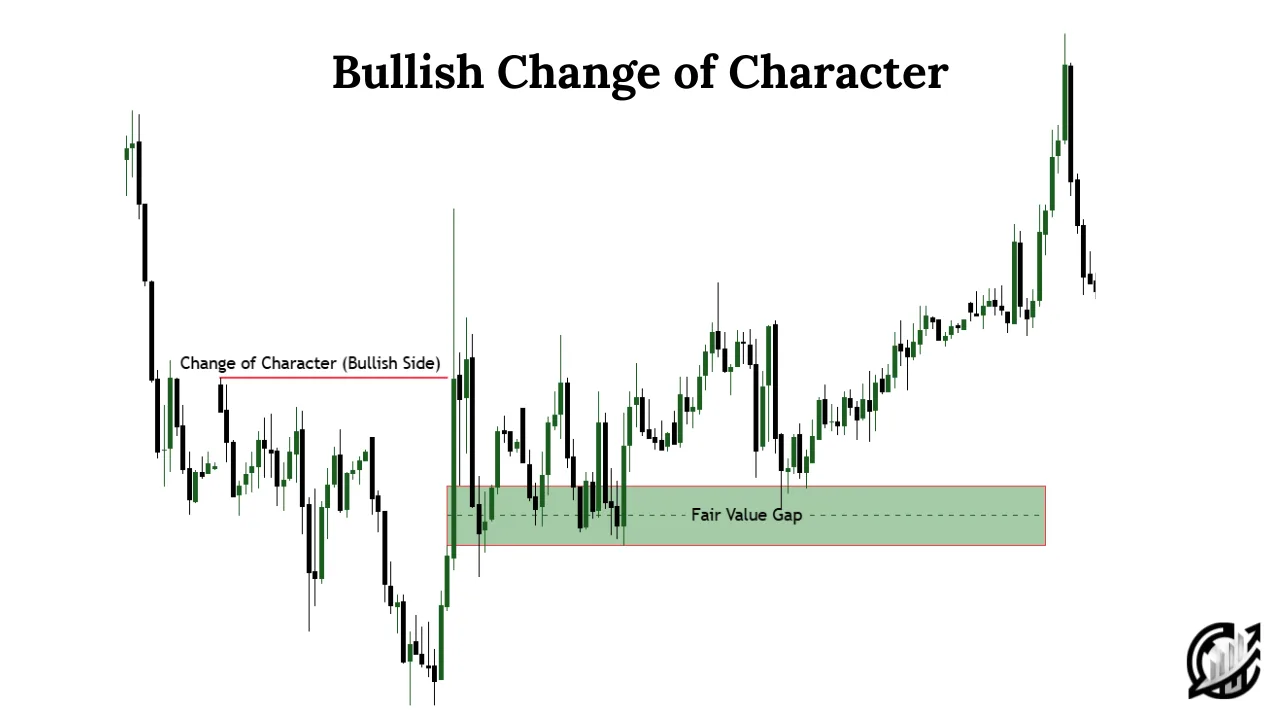
Change of character in Bullish Market (Uptrend)
Change of character in a bullish market is referred to as a bearish change of character. In an uptrend, the market creates higher highs and higher lows. A change of character from bullish to bearish is a critical moment. This is because the market signals a potential reversal. It occurs in the following way:
As the bullish trend continues, there comes a time when the price fails to create a new higher high. This is an indication of weakening buying pressure. This weakening of buying pressure sometimes leads to a change of interest, and the market may go sideways for a moment (Wyckoff referred to the phases as accumulation or distribution phases).
The first sign of a potential reversal happens when the price fails to respect the previous higher low. This is also referred to as “Break of structure in the opposite direction.” Price breaks below this higher low, creating a Lower Low. This break is significant in market structure because it represents that sellers are gaining strength.
After that, price retraces back but fails to break above the previous higher high. On the contrary, it creates a lower high. This confirms the bearish structure. If price forms another lower low, it indicates potential strength in a trend reversal. This is the end of the bullish trend phase and the continuation of the bearish one.

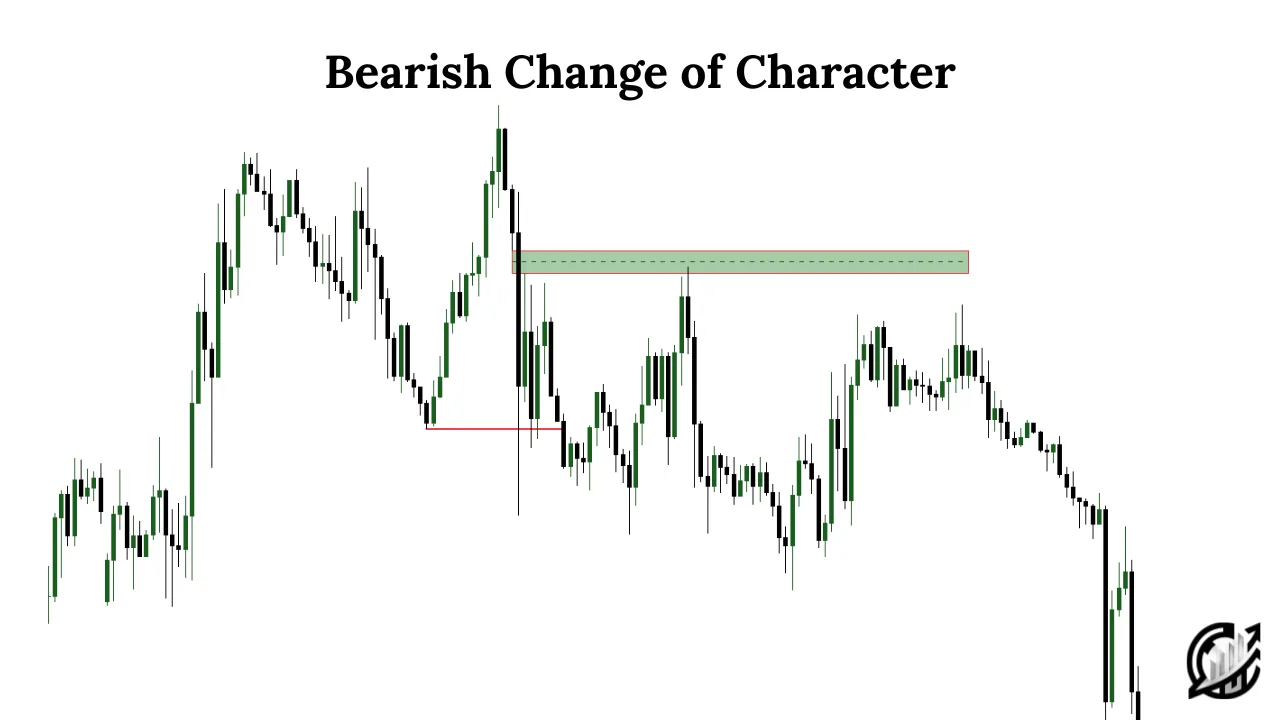
A bearish Change of Character is a critical concept in technical analysis, indicating a trend reversal from bullish to bearish. By breaking the structure of Higher Lows and forming Lower Lows, the market signals that the upward momentum is weakening, and sellers are gaining control. For traders, recognizing this shift can provide potential opportunities to enter short positions in the early stages of a new bearish trend.
CHOCH Trading Strategy
Here are simplified steps for the CHOCH trading strategy:
- Identify the current trend on your chosen higher timeframe.
- Mark the key structural point that must break for a valid CHOCH.
- Wait for a confirmed candle close beyond that level, ideally with strong displacement.
- Note any fair value gap or order block created by the break.
- Wait for a retracement into that zone before considering an entry — this is often referred to as a CHOCH plus FVG setup.
- Confirm with lower timeframe structure before entering, and place your stop loss beyond the recent extreme.
This strategy works best alongside multi-timeframe analysis. The higher timeframe is used to establish bias, and the lower timeframe to refine your entry.
CHOCH and SMC Confluence
There are other concepts of SMC and ICT that can be integrated with CHOCH. The addition of these concepts can give strength to our analysis of market structure.
Order Blocks are the first among our additional considerations. Order Blocks are areas where meaningful institutional buying or selling occurs. In ICT and SMC, these zones are often critical in determining market structure. Beware of inducement zones. At first sight, these zones are identified as order blocks. That is, traders recommend using premium and discount zones for buying and selling.
Looking for Liquidity in SMC and ICT analysis is key. Liquidity is the fuel of the market. Liquidity pools are areas where clusters of stop-loss or pending orders are expected to be triggered. ICT emphasizes liquidity runs. These moves often precede a CHOCH, as the market takes out the weak hands before establishing a new trend.
Fair Value Gaps (FVGs) or Imbalances occur when there’s an unevenness in buying and selling pressure, leaving a price gap on the chart. The price often returns to fill these gaps before a CHOCH occurs. For instance, in a bullish trend, the price might fill an FVG and then break the last Higher Low, signaling a bearish CHOCH. In contrast, in a bearish trend, the price might fill an FVG and then break the last Lower High, indicating a bullish CHOCH.
Multiple Time Frame Analysis is crucial in both ICT and SMC strategies, as it helps traders align higher time frame trends with lower time frame entries. A CHOCH on a higher time frame (e.g., daily or weekly) carries more significance and is more reliable than one on a lower time frame (e.g., 1-hour or 15-minute). Traders often wait for a higher time frame CHOCH before looking for entries on lower time frames.
These are a few of the concepts. Combining Change of Character (CHOCH) with ICT and SMC concepts offers a powerful foundation for identifying and trading trend reversals with precision.
Final Note
Change of Character (ChoCH) trading strategies, combined with ICT and SMC concepts, offer powerful tools for identifying market reversals. However, they carry inherent risks. Not all ChoCH signals lead to sustained trends, and market conditions can change rapidly. Always practice prudent risk management, use stop-losses, and never risk more than you can afford to lose. Continuous learning and disciplined execution are essential for long-term success in trading.

I’m Abdullah Shah, a content writer with three years of experience in crafting engaging and informative content. My background in market analysis complements my work, allowing me to create content that resonates with audiences. I’m also a seasoned practitioner in the forex and crypto markets, with a strong foundation and deep interest in finance. My passion for the financial world drives me to produce content that is both insightful and valuable for those interested in understanding market trends and financial strategies.